

Introduction
For more than a decade, smartphones have controlled how people communicate, shop, learn, work, create content, and manage daily life. But now, tech giants envision future beyond smartphones because mobile innovation is slowing, artificial intelligence is becoming more powerful, and users want faster, more natural ways to interact with technology.
The positive side is that this new future could make digital life more helpful, hands-free, and personalized. The negative side is that it may also raise serious concerns about privacy, screen addiction, data control, and the growing influence of big technology companies.
Quick Bio
| Field | Details |
|---|---|
| Main Topic | Tech Giants Envision Future Beyond Smartphones |
| Key Companies | Apple, Google, Meta, Samsung, Microsoft, Qualcomm |
| Main Focus | AI assistants, AR glasses, smart wearables, and spatial computing |
| Future Vision | A digital world where smartphones are no longer the main device |
| Core Technologies | Artificial intelligence, augmented reality, mixed reality, smart glasses, smartwatches, smart rings, and voice control |
| User Benefit | Faster, hands-free, personalized, and more natural digital experiences |
| Main Concern | Privacy, data security, device cost, and overdependence on big tech |
| Current Status | Still developing, while smartphones remain important |
| Expected Shift | Smartphones may become support devices instead of the center of digital life |
Why Tech Giants Envision Future Beyond Smartphones
Smartphone growth has reached a mature stage. Every year, companies improve cameras, processors, displays, and batteries, but many users no longer feel that each new phone is a major upgrade. This creates pressure on technology companies to find the next big computing platform.
Another reason is user behavior. People want technology that understands context, responds instantly, and works without constant tapping and scrolling. This is why artificial intelligence, ambient computing, and wearable technology are becoming key parts of the post-smartphone future.
The Role of Artificial Intelligence in the Future of Smartphones
Artificial intelligence is one of the biggest reasons tech giants envision future beyond smartphones. AI assistants can understand voice commands, summarize information, organize tasks, answer questions, write messages, translate languages, and help users make faster decisions.
In the past, users opened apps to complete every action. In the coming years, AI agents may perform many of those actions automatically. Instead of searching through apps, a person may simply ask an AI assistant to book a meeting, compare prices, plan a trip, edit a photo, or summarize emails.
AI Assistants as the New Digital Interface
AI assistants are becoming more than simple chat tools. They are moving toward becoming personal digital managers that understand routines, preferences, location, calendar activity, and communication patterns.
This shift could reduce the need to constantly hold a smartphone. If AI can work across glasses, earbuds, watches, laptops, cars, and home devices, the phone becomes only one part of a larger connected ecosystem.
Human Benefit of AI-Powered Computing
The biggest benefit of AI-powered computing is convenience. People may spend less time navigating menus and more time getting direct answers or completed tasks.
However, the challenge is trust. Users will need clear control over what AI can access, what it can do automatically, and how personal data is protected.
AR Glasses and Smart Wearables May Replace Phone Screens
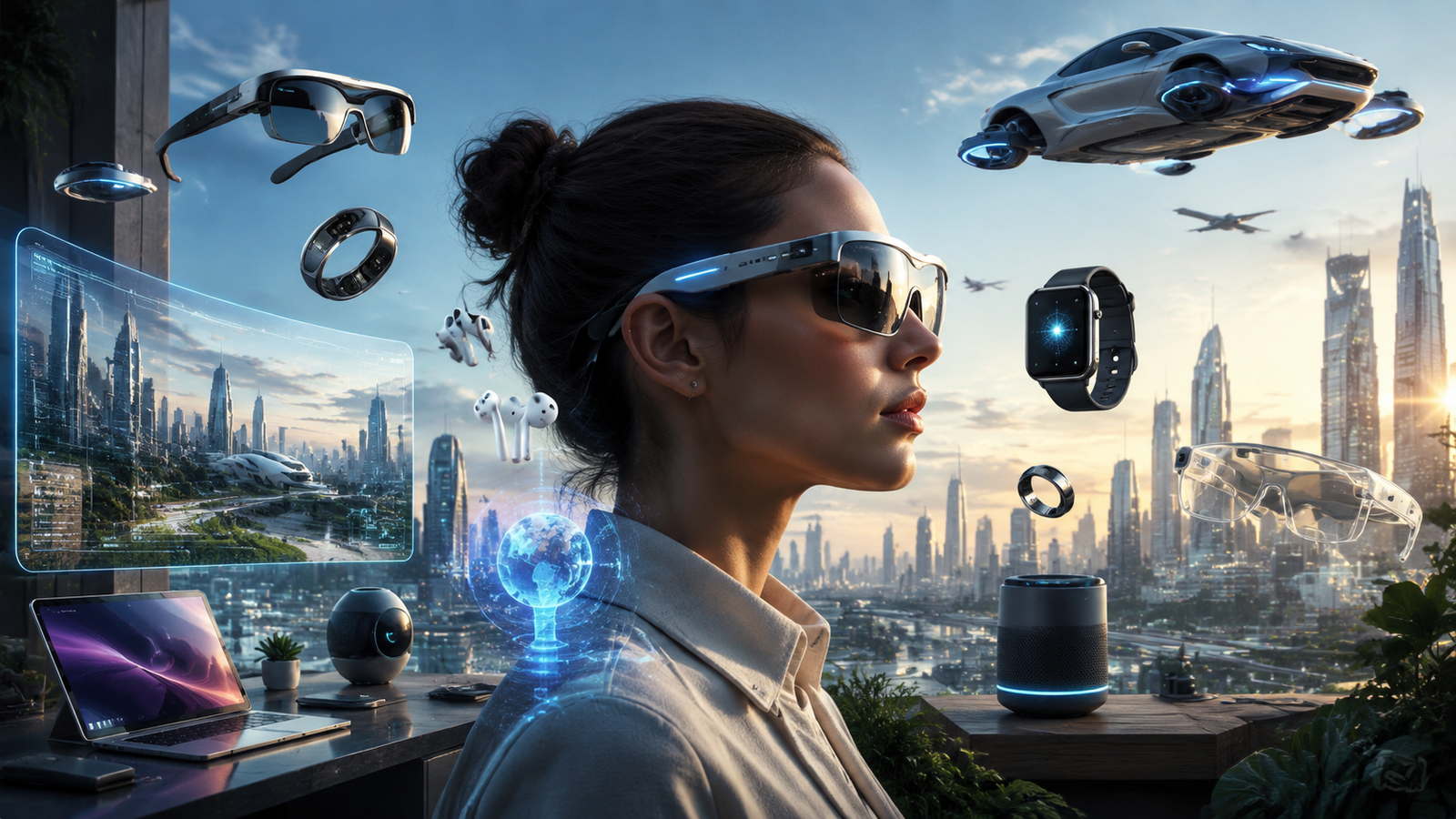
Augmented reality glasses are one of the strongest candidates for the future beyond smartphones. Companies are exploring smart glasses that can display navigation, messages, translations, video calls, digital objects, and real-time information directly in front of the user.
Smart wearables also play an important role. Smartwatches, fitness bands, smart rings, earbuds, and health sensors can collect useful data and give quick updates without requiring a phone screen. These devices make technology feel more natural and less distracting.
Why Smart Glasses Matter
Smart glasses could change how people interact with the digital world. Instead of looking down at a phone, users may see helpful information layered over the real world. This could support work, education, travel, gaming, shopping, and accessibility.
For example, a traveler could see live directions while walking. A student could view study notes during a lesson. A worker could receive hands-free instructions while repairing equipment. These examples show why tech giants are investing heavily in augmented reality and mixed reality.
The Challenge of Wearable Adoption
Even with strong potential, smart glasses still face challenges. They must be lightweight, stylish, affordable, comfortable, private, and powerful enough for daily use.
Battery life, social acceptance, camera privacy, and display quality are also important issues. Until these problems are solved, smartphones will remain more practical for many users.
Spatial Computing and Mixed Reality Are Changing Digital Experiences
Spatial computing allows users to interact with digital content in a three-dimensional environment. Instead of using a flat screen, people can work with virtual windows, 3D objects, immersive apps, and mixed reality spaces.
This technology is especially important for gaming, design, training, education, entertainment, remote collaboration, and professional workflows. It gives users a more immersive way to experience digital content beyond the small smartphone display.
From Mobile Apps to Immersive Environments
The app-based smartphone model changed the internet by putting services into small icons. Spatial computing may change that model again by placing digital tools around the user in real space.
A designer could view a 3D model in a room. A doctor could study medical visuals in a more interactive format. A team could meet inside a virtual workspace. These uses show why big technology companies see spatial computing as a serious long-term opportunity.
Why This Future Is Still Developing
Spatial computing is exciting, but it is not yet ready for everyone. Devices can be expensive, heavy, or limited by battery life and app availability.
For mass adoption, companies must create lighter hardware, stronger software, better comfort, and clear everyday use cases that regular people actually need.
Smartphones Will Not Disappear Suddenly
Even though tech giants envision future beyond smartphones, the smartphone is still one of the most useful devices ever created. It combines communication, camera, banking, entertainment, productivity, maps, shopping, and identity tools in one portable product.
The more realistic future is not the death of smartphones but a shift in importance. Phones may become control hubs while AI assistants, smart glasses, earbuds, cars, watches, and home devices handle more daily interactions.
The Smartphone as a Backup Hub
In the future, people may not look at their phone as often, but they may still carry it for security, storage, payments, camera quality, and deeper tasks. It could become the device that connects everything quietly in the background.
This is similar to how laptops did not disappear when smartphones became popular. Instead, laptops became more specialized for work, while phones became central for everyday use. The same pattern may happen again.
A Balanced View of the Future
A post-smartphone future sounds powerful, but it must serve real human needs. Technology should reduce friction, not create more confusion.
The best future will not be about replacing one screen with another. It will be about creating smarter, safer, easier, and more natural ways for people to live with digital tools.
FAQs
What does “tech giants envision future beyond smartphones” mean?
It means major technology companies are planning for a future where smartphones are no longer the main way people interact with digital services. Instead, users may rely more on AI assistants, smart glasses, wearables, voice commands, and spatial computing devices.
Will smartphones disappear in the future?
Smartphones are unlikely to disappear quickly. They may remain useful for many years, but their role could become less central as other devices become smarter, more affordable, and easier to use.
What technology could replace smartphones?
The most likely technologies are augmented reality glasses, AI assistants, smartwatches, smart rings, wireless earbuds, mixed reality headsets, and ambient computing systems. These tools may work together rather than fully replacing the smartphone with one device.
Why are companies investing in AR glasses?
Companies are investing in AR glasses because they can show digital information in the real world. They may help with navigation, translation, communication, education, work tasks, gaming, and hands-free productivity.
How will AI change mobile technology?
AI may reduce the need to open multiple apps manually. Users could ask an AI assistant to complete tasks, summarize content, manage schedules, write messages, or control devices across a connected ecosystem.
Are smart wearables part of the post-smartphone future?
Yes, smart wearables are a major part of the future beyond smartphones. Watches, rings, earbuds, and glasses can provide health tracking, notifications, voice control, payments, and quick access to digital information.
Is the future beyond smartphones good or bad?
It can be both. The good side is convenience, accessibility, and smarter digital support. The bad side includes privacy risks, higher dependence on big tech companies, possible distraction, and data security concerns.
When will the post-smartphone future arrive?
The transition is already happening slowly through AI tools, smartwatches, earbuds, AR experiments, and mixed reality devices. However, smartphones will likely remain important until future devices become more practical, affordable, and widely accepted.
Read More: Laura Deibel: The Untold Story of Tim Allen’s First Wife and Her Private Life
Conclusion
Tech giants envision future beyond smartphones because the next phase of technology is moving toward artificial intelligence, augmented reality, smart wearables, spatial computing, and connected ecosystems. The goal is to make computing more natural, personal, and available without forcing users to constantly depend on a phone screen.
Still, smartphones are not going away soon. They will likely remain important while slowly becoming part of a larger digital environment. The real future is not one single replacement device. It is a smarter network of AI-powered tools that work together around the user.